Introduction
Grid trading and martingale are two of the most discussed automated forex strategies, and they are frequently confused with each other. Both involve placing multiple orders as price moves against you. Both can show impressive short-term results. But the way they handle risk is fundamentally different — and that difference determines whether your account survives long-term or eventually hits zero.
This article is built around tables. It compares the two systems side by side, runs a concrete 200-pip scenario through both, and gives you a parameter-sheet test you can apply to any EA in under a minute to find out which one you are actually running. If you haven’t read our grid trading strategy guide yet, this comparison will make more sense with that context first, and what is grid trading covers the concept from scratch.
Quick Answer
Grid trading and martingale differ in exactly one parameter: whether lot size changes as the ladder fills. A fixed-lot grid holds the multiplier at 1.0, so risk grows linearly and the worst case is calculable before entry. Pure martingale uses a 2.0 multiplier, so risk grows geometrically — starting from 0.01 lots, level 8 is 1.28 lots and total exposure after eight levels is 2.55 lots, against 0.01 and 0.08 for the fixed-lot grid. The grid martingale hybrid sits between them at a typical 1.2–1.7 multiplier and is where most retail damage happens, because it is sold under the safer word. You can tell which one you are running in under a minute: read the input parameter list, and treat any input named lot multiplier, lot factor, martingale multiplier, lot exponent or increment set above 1.0 — or a “recovery mode” or “averaging” switch — as escalation.
Checking an EA’s parameter sheet? Our free GridMaster EA ships with a flat 1.0 lot multiplier by default and a hard
MaxLotSizecap, and every grid input is exposed so you can audit it against the table below. Download all 7 free MT4 & MT5 EAs →
The Three Systems, in One Table
Almost every argument about grid trading and martingale is really an argument about one parameter: whether lot size changes as the ladder fills. That single choice produces three distinct systems.
| Fixed-lot grid | Grid martingale hybrid | Pure martingale | |
|---|---|---|---|
| Lot multiplier | 1.0 (none) | Typically 1.2–1.7 | 2.0 |
| Size at level 8, from 0.01 | 0.01 | 0.04 at 1.2× / 0.41 at 1.7× | 1.28 |
| Total exposure after 8 levels | 0.08 lots | 0.16 lots at 1.2× / 0.98 at 1.7× | 2.55 lots |
| Risk curve | Linear | Geometric, moderate base | Geometric, base 2 |
| Worst-case drawdown | Calculable before entry | Calculable, but scales fast | Bounded only by account size |
| Fails when | Trend outruns your capital cap | Trend outruns a much lower cap | Any streak longer than your level count |
| Marketed as | “Grid EA” | “Grid EA”, “recovery EA”, “smart grid” | Rarely named honestly |
The middle column is where most retail damage happens, because it is sold under the safer word. The rest of this article works through why.
Grid Martingale EAs: What They Are and How to Spot One
A grid martingale EA is a hybrid: it ladders orders at fixed price intervals like a grid, but escalates lot size at each successive level like a martingale instead of holding the lot size constant. On a chart the two look identical — evenly spaced orders, the same ladder shape. The difference is invisible until the trend that fills the ladder arrives, at which point it is the only thing that matters.
We do not publish a grid martingale EA for this reason. GridMaster, our own grid EA, ships with fixed lot sizes by default so its risk stays linear and calculable in advance, and its parameter table contains no lot multiplier to raise.
Why blown accounts trace back to hybrids
The failure pattern is consistent enough to be predictable, and it has three stages.
- The hybrid works, visibly and for a long time. Escalating size at deeper levels means the average entry price sits closer to the current price, so a smaller retracement closes the whole basket in profit. In ranging conditions a hybrid recovers faster and more often than a fixed-lot grid, which is exactly what makes it persuasive. Months of clean equity curve are normal, not surprising.
- The reader concludes the risk is theoretical. Nothing in the account statement warns you. There is no partial failure mode, no gradual degradation, no smaller version of the event that lets you learn cheaply. The system either recovers or it does not.
- One trend fills more levels than the multiplier can survive. Because exposure compounds, the deepest few levels carry most of the position. A 1.5× multiplier from 0.01 reaches 0.17 lots at level 8 and 1.30 lots at level 13 — and the margin required arrives faster than the drawdown does, so the account is often stopped out by margin call before the strategy’s own logic ever gets a chance to close the basket.
The generalisable point: a fixed-lot grid in a bad trend gives you a large loss. A hybrid in the same trend gives you a terminal one. Both are bad; only one leaves an account to trade the next month with.
How to read an EA’s parameter sheet
You do not need the source code. The input list an EA exposes when you attach it to a chart tells you everything, if you know which names to look for.
| What you see in the inputs | What it means | Verdict |
|---|---|---|
LotMultiplier, LotFactor, Multiplier set above 1.0 | Each level is sized larger than the last | Martingale element present |
LotExponent, LotIncrement, SizeStep above 1.0 (or above 0) | Same thing, different vocabulary | Martingale element present |
RecoveryMode, Averaging, HedgeRecovery, SmartRecovery enabled | Almost always escalation under a friendlier name | Assume martingale until proven otherwise |
MaxTrades / MaxLevels with no multiplier field | A capped fixed-lot ladder | Grid, linear risk |
A single Lots value, or RiskPercent with no multiplier | Every level the same size | Fixed-lot grid |
| No parameter sheet published at all | Undisclosed sizing logic | Do not run it |
Two practical checks beyond reading names. First, set the multiplier to 1.0 if the input exists and see whether the vendor’s advertised results survive — if the whole case for the EA disappears, the results were coming from escalation rather than from an edge. Second, run it on demo and watch the trade list: if the lot size in row 8 is larger than the lot size in row 1 of the same basket, escalation is active regardless of what the marketing page says.
The same reasoning is the fifth item on our general EA selection checklist — no martingale or loss-averaging logic — and the reason our EA lineup states plainly that none of the seven uses it.
What Is Grid Trading?
Grid trading places buy and sell orders at fixed price intervals using equal lot sizes at every level. As price oscillates, each completed round-trip (order opened at one level, closed at the next) generates a fixed profit.
The key characteristic: every position is the same size. Whether it is the first grid level or the tenth, the lot size does not change. This means risk grows linearly with the number of open positions.
What Is Martingale?
Martingale originated as a betting strategy in 18th-century France. The core rule is simple: after every loss, double your stake. When you eventually win, the single win recovers all previous losses plus a profit equal to the original stake.
In forex, martingale works like this:
- Open a trade with 0.01 lot.
- If the trade hits the stop loss (e.g., 20 pips), open the next trade with 0.02 lot.
- If that trade also loses, open the next with 0.04 lot.
- Continue doubling until a trade wins, which recovers all accumulated losses.
The mathematical appeal is obvious: you “always” win eventually. The practical problem is equally obvious: the lot sizes grow exponentially, and your account balance does not.
Lot progression in a pure martingale:
| Loss # | Lot Size | Cumulative Risk (at 20 pips each) |
|---|---|---|
| 1 | 0.01 | $2 |
| 2 | 0.02 | $6 |
| 3 | 0.04 | $14 |
| 4 | 0.08 | $30 |
| 5 | 0.16 | $62 |
| 6 | 0.32 | $126 |
| 7 | 0.64 | $254 |
| 8 | 1.28 | $510 |
By the 8th loss, you are trading 128 times your original lot size and have accumulated over $500 in losses — from a strategy that started with $2 trades.
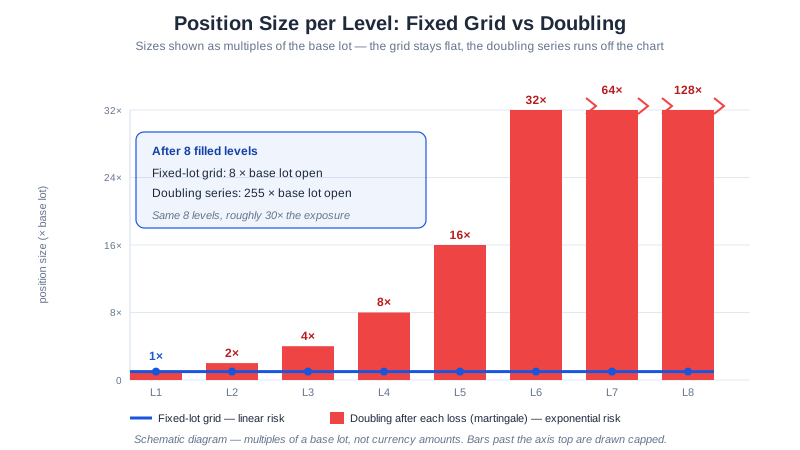
That picture is the whole argument. Both approaches add positions as price moves against them, so both feel similar while they are working. The difference is what the eighth level costs you: one more base lot in a grid, or 128 of them in a doubling series.
Side-by-Side Comparison
| Factor | Grid Trading (Fixed Lots) | Martingale |
|---|---|---|
| Lot sizing | Same size at every level | Doubles (or increases) after each loss |
| Direction | Both buy and sell orders | Typically one direction, increasing size |
| Risk curve | Linear | Exponential |
| Max drawdown | Predictable, calculable in advance | Theoretically unlimited |
| Recovery mechanism | Multiple small wins over time | Single large win recovers all losses |
| Profit per trade | Fixed, equal to grid spacing | Varies, always equals original stake |
| Capital requirement | Moderate, scales linearly | Extreme, scales exponentially |
| Long-term survival | Sustainable with proper risk management | Approaches 0% over sufficient time |
| Best market condition | Ranging/sideways markets | Very short-term mean reversion |
| Worst-case scenario | Drawdown proportional to trend size | Account blown after N consecutive losses |
Risk Analysis: A 200-Pip Scenario
To make the risk difference concrete, consider what happens when EUR/USD moves 200 pips in one direction (a common occurrence during news events or trend days) with 20-pip intervals.
Grid Trading: Linear Risk
With a fixed lot of 0.01 at each level and 20-pip spacing:
| Level | Entry | Lot Size | Unrealized Loss |
|---|---|---|---|
| 1 | +20 pips | 0.01 | $2.00 |
| 2 | +40 pips | 0.01 | $4.00 |
| 3 | +60 pips | 0.01 | $6.00 |
| 4 | +80 pips | 0.01 | $8.00 |
| 5 | +100 pips | 0.01 | $10.00 |
| 6 | +120 pips | 0.01 | $12.00 |
| 7 | +140 pips | 0.01 | $14.00 |
| 8 | +160 pips | 0.01 | $16.00 |
| 9 | +180 pips | 0.01 | $18.00 |
| 10 | +200 pips | 0.01 | $20.00 |
| Total | 0.10 lot | $110.00 |
Total exposure: 0.10 lot. Total unrealized loss: $110. On a $1,000 account, this is an 11% drawdown — significant but survivable. When price reverts, each level closes independently, gradually recovering the drawdown.
Martingale: Exponential Risk
With the same starting lot of 0.01 and 20-pip loss triggers:
| Level | Entry | Lot Size | Loss at This Level | Cumulative Loss |
|---|---|---|---|---|
| 1 | +20 pips | 0.01 | $2.00 | $2.00 |
| 2 | +40 pips | 0.02 | $4.00 | $6.00 |
| 3 | +60 pips | 0.04 | $8.00 | $14.00 |
| 4 | +80 pips | 0.08 | $16.00 | $30.00 |
| 5 | +100 pips | 0.16 | $32.00 | $62.00 |
| 6 | +120 pips | 0.32 | $64.00 | $126.00 |
| 7 | +140 pips | 0.64 | $128.00 | $254.00 |
| 8 | +160 pips | 1.28 | $256.00 | $510.00 |
| 9 | +180 pips | 2.56 | $512.00 | $1,022.00 |
| 10 | +200 pips | 5.12 | $1,024.00 | $2,046.00 |
By level 9, the cumulative loss exceeds $1,000 — the entire account balance. Most brokers would issue a margin call at level 7 or 8. The account is effectively blown.
Total exposure at level 10: 5.12 lots — 512 times the original position. Compare that to the grid trader’s 0.10 lots (10 times the original).
The same 200-pip move produces an 11% drawdown for the grid trader and a 100%+ account loss for the martingale trader.
When Each Strategy Works Best
Martingale
Martingale can produce short-term profits under very specific conditions:
- Very short-term mean reversion with strict caps (e.g., maximum 3-4 doublings)
- Pairs with strong mean-reverting tendencies during low-volatility sessions
- Extremely large accounts relative to position sizing (allowing 10+ doublings)
- Combined with a hard stop that abandons the martingale sequence before it reaches critical levels
Even under these conditions, the long-term expected value is negative once you account for the inevitable streak that exceeds your cap. Professional traders who use martingale-like systems typically limit the progression to 2-3 levels and accept the loss rather than continuing to double.
Grid Trading
Grid trading produces the best results when:
- Markets are ranging with identifiable support and resistance levels
- Volatility is moderate (enough to trigger grid levels, not so much that it overwhelms the grid)
- The trader has calculated capital requirements correctly for worst-case scenarios
- Proper risk management layers are in place (drawdown stops, position caps, weekend close)
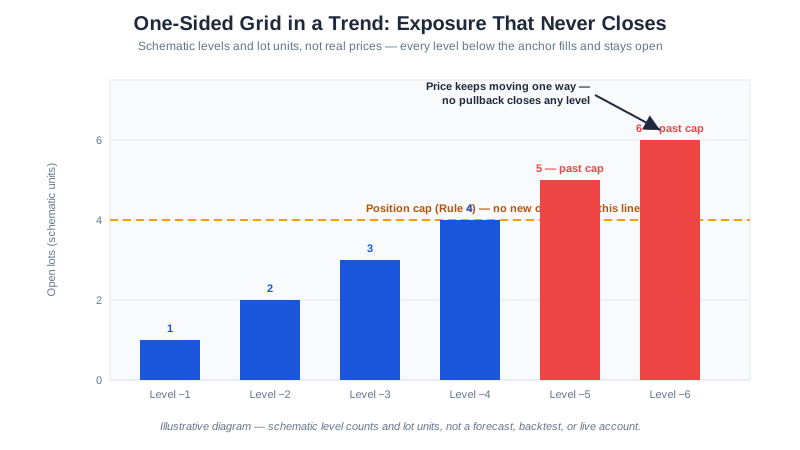
Grid trading is not profitable during strong, extended trends. But unlike martingale, the losses during trends are predictable and bounded. A grid trader who sets a 20% maximum drawdown stop knows exactly when and how the grid will be shut down.
The safe way to make a grid more adaptive is through its spacing, not its lot size. Dynamic grid trading widens the interval as volatility rises, which slows how quickly the ladder fills while leaving every position the same size — the opposite of the martingale adjustment, which leaves the interval alone and grows the exposure instead.
Can You Combine Them? The Hybrid Numbers
This is the grid martingale hybrid described earlier, with the arithmetic filled in. Each successive grid level increases the lot size by a moderate factor — 1.3× instead of 2× is a common vendor default. The logic is that larger positions at more extreme levels pull the basket’s average entry closer to price, so it recovers faster when price reverts.
Example with 1.3x lot increase:
| Level | Lot Size | vs Fixed | vs 2x Martingale |
|---|---|---|---|
| 1 | 0.01 | 0.01 | 0.01 |
| 2 | 0.013 | 0.01 | 0.02 |
| 3 | 0.017 | 0.01 | 0.04 |
| 4 | 0.022 | 0.01 | 0.08 |
| 5 | 0.029 | 0.01 | 0.16 |
| 6 | 0.037 | 0.01 | 0.32 |
The growth is much slower than pure martingale, and the risk curve is closer to linear than exponential. However, it still amplifies risk at the worst possible time — when your position is deepest underwater. Unless you have extensive backtesting data showing this approach outperforms fixed lots on a risk-adjusted basis, and a large enough capital buffer to handle the increased drawdown, fixed lot sizes remain the safer choice.
Enter your own spacing, lot size, multiplier, and cap below to run this comparison with numbers other than the illustrative 1.3x above, including a level-by-level breakdown of where a fixed lot and your entered multiplier diverge.
Grid blow-up simulator
Enter spacing, lot size, cap, pair, equity, and an adverse move above to run the simulation.
Educational tool, not investment advice. Margin, swap, and spread are not modelled — only the pip-distance floating loss per level. A real account can be stopped out by margin before this simulation's cumulative loss is reached. Verify against your own broker's contract specification and margin requirements.
Our Recommendation
For the majority of retail forex traders, grid trading with fixed lot sizes is the safer and more sustainable approach. Here is why:
Predictable risk. You can calculate your maximum possible drawdown before placing a single trade. With martingale, the risk is theoretically unbounded.
Survivability. Grid trading accounts survive adverse moves as long as the drawdown stays within calculated limits. Martingale accounts face certain destruction given enough time.
Psychological sustainability. Watching a 0.01-lot grid accumulate positions is stressful but manageable. Watching a martingale sequence reach 1.28 lots while your account drains is panic-inducing and leads to irrational decisions.
Compounding works. Because grid trading accounts survive, they can compound gains over months and years. Martingale accounts tend to produce impressive returns for 3-6 months before a single event wipes out all gains and the principal.
GridMaster EA uses fixed lot sizes by default with five layers of risk protection. You can download it for free from the SteadyPips download page and test it on a demo account before committing real capital. Open an XM account to get started with a broker that supports MT4, hedging, and automated trading.
Further Reading
- Grid Trading Strategy: How It Works + Free EA — Complete grid trading guide
- How to Set Up Grid Trading in Forex — Step-by-step setup instructions
- How dynamic grids adapt spacing to volatility — adapting the interval instead of the lot size
- Grid Trading MT4 EA: Free Download — Download GridMaster EA
- Forex Risk Management Guide — Essential risk management principles
- How to Backtest a Forex EA — Validate any strategy before going live
Both grid trading and martingale strategies carry significant risk of capital loss. Grid trading can produce large drawdowns during trending markets, and martingale strategies can result in total account loss. This article is for educational purposes only and does not constitute financial advice. Past performance is not indicative of future results. Always trade with money you can afford to lose.