Understanding Forex Spreads and Commissions
Every forex trade costs money before it has any chance of making money. The spread alone is the part most beginners learn about; it is one line in a longer cost stack, and the strategies that get hurt worst by that stack are exactly the ones — scalping, high-frequency EAs — that look best in a backtest that under-counts costs.
Cost is a recurring theme across our forex trading for beginners roadmap, and it is easy to underestimate until you see it added up.
What Is a Spread?
The spread is the difference between the bid (sell) and ask (buy) price. If EUR/USD shows Bid 1.0800 / Ask 1.0802, the spread is 2 pips. The instant you open a trade you are down that amount, and price has to move in your favour by at least the spread before you reach break-even.
Fixed spreads stay constant regardless of conditions, easier to plan around but usually wider on average. Variable spreads move with liquidity — tight in deep markets, capable of widening sharply around news or in thin, low-liquidity hours.
Cost as a Fraction of Your Edge
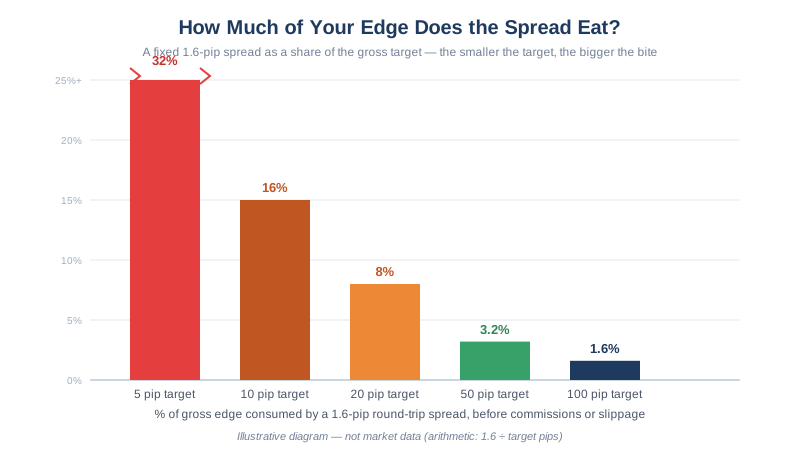
This is the calculation that actually matters, and it’s simple arithmetic: spread ÷ target size = the fraction of your gross edge the spread consumes, before commission or slippage are even added.
| Target size | 1.6-pip spread as % of target |
|---|---|
| 5 pips | 32% |
| 10 pips | 16% |
| 20 pips | 8% |
| 50 pips | 3.2% |
| 100 pips | 1.6% |
Take a concrete strategy: a 12-pip average win against a 10-pip average loss. That edge — the difference between what you make and what you risk — is only a few pips wide to begin with. A 1.6-pip round-trip spread taken out of a 12-pip win is over 13% of the win alone, before commission or slippage. Shrink the target further, toward a scalping horizon, and the same fixed spread consumes a larger and larger share of a smaller and smaller edge, which is exactly why cost management matters more, not less, the shorter the trade.
The Full Forex Trading Cost Stack
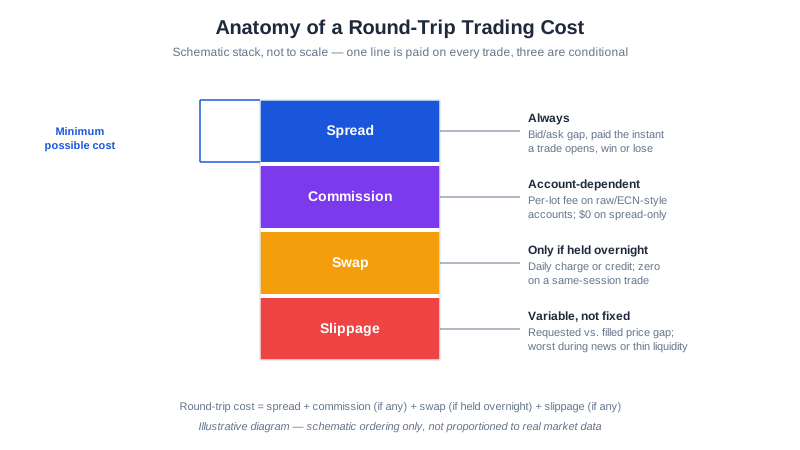
Spread is one line item, not the whole bill:
- Spread — paid on every trade, every time, win or lose
- Commission — a fixed per-lot fee on raw/ECN-style accounts, in addition to a (usually much tighter) spread
- Swap/rollover — a daily charge or credit for holding a position overnight, detailed below
- Slippage — the gap between the price you requested and the price you got, worst during news and low liquidity
- Conversion cost — a small markup when your account currency differs from the pair you’re trading
- Inactivity and withdrawal fees — account-level charges some brokers apply, unrelated to any individual trade
Any cost comparison that only looks at the advertised spread is comparing one line out of six. If you want to add those lines up for a specific trade rather than read about them, our companion guide on what a round trip actually costs walks the calculation through in your own account currency.
Leverage Caps and the Cost Picture for FCA/ESMA/ASIC Accounts
The full cost stack above is the same everywhere, but what it costs you as a share of your account changes once regulation sets a leverage ceiling. ESMA capped retail leverage on major FX pairs at 30:1 for EU traders (Board of Supervisors decision, 23 March 2018, effective 1 August 2018, as published by ESMA), the FCA applied and later confirmed the same structure for UK retail clients under its 2019 rules, and ASIC set the same 30:1 cap on major FX pairs for Australian retail clients from 29 March 2021, as published by ASIC. None of that changes the spread or commission on a single trade — a 1.6-pip spread costs the same 1.6 pips whether your leverage is 30:1 or 1:500. What it changes is how much margin a given position size requires: at 30:1, one standard EUR/USD lot needs roughly $3,600 of margin at a typical major-pair rate, against roughly $200 at 1:500 offshore. A UK, EU, or Australian trader sizing an account around that margin requirement is committing a larger fraction of their capital to hold the same lot size, so the same per-trade spread and commission cost lands as a smaller percentage of margin used but the same percentage of notional traded — worth separating out before comparing your account’s cost efficiency to a screenshot from an unregulated, high-leverage offshore account running a smaller balance.
This also matters directly for running an EA: if you’re planning to trade automatically, our MT4 vs MT5 for Expert Advisors guide and backtesting guide both cover how a capped-leverage account changes the deposit size a backtest’s position sizing assumes.
Swap, Worked
Swap is a daily interest-rate differential charge or credit for holding a position overnight, applied around 5pm New York time on most platforms. Two illustrative (not live-quoted) examples:
- Positive carry: holding a currency with a higher interest rate against one with a lower rate can pay you a small daily credit — illustratively, a few cents per 0.1 lot per night.
- Negative carry: the reverse position pays the difference instead, as a small daily charge.
Triple-swap Wednesday: because spot forex trades settle two business days later, most brokers apply swap at three times the normal rate on positions held over a Wednesday close, to cover the weekend when no settlement happens. This is a standard, published mechanic, not a fee applied in error — check your broker’s swap schedule before holding a swap-negative position into a Wednesday close.
If the interest component itself is the issue rather than just the cost, some brokers offer a swap-free (Islamic) account variant that restructures how this charge is applied. See our swap-free (Islamic) forex accounts guide for how that works, who qualifies, and the conditions that still apply.
Standard vs Ultra Low: The Break-Even Math
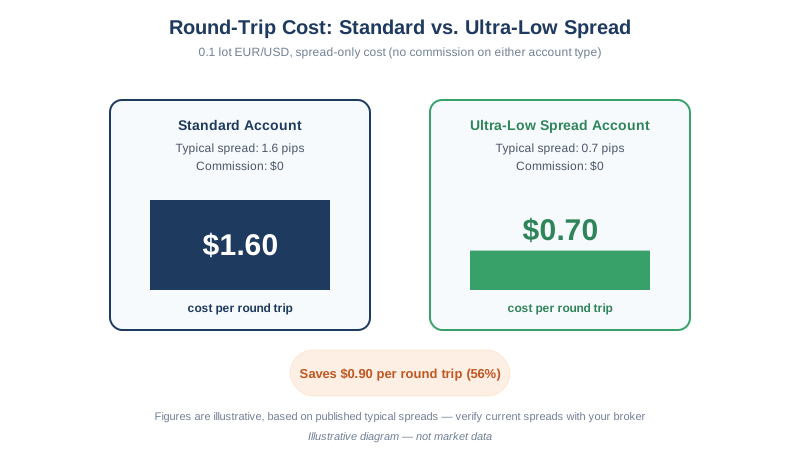
On a 0.1 lot EUR/USD round trip, at illustrative published typical spreads: a Standard account at 1.6 pips costs about $1.60; an Ultra Low account at 0.7 pips costs about $0.70 — a saving of $0.90, or 56%, per round trip. That comparison holds only while Ultra Low carries no separate commission; where it does, add the commission back in before comparing, since a tighter spread plus a commission can cost more than a wider spread with none, depending on lot size and trade count.
Worked Example: One Full Round-Trip, Every Cost Line Combined
The sections above cover each cost line on its own. Here they’re combined into a single trade, the way costs actually stack in an account — not the spread viewed in isolation.
Take a 0.5 lot EUR/USD position, held open long enough to cross one overnight swap, on a Standard account carrying the same illustrative 1.6-pip round-trip spread used throughout this guide. Scaling that spread cost linearly from the $1.60-per-0.1-lot figure above:
- Spread: 0.5 lot is five times the 0.1 lot base size, so 5 × $1.60 = ≈$8.00 (illustrative, scaled from the published-typical figure above — not a live quote)
- Commission: $0 — Standard accounts build the cost into the spread rather than charging a separate per-lot fee
- Swap: a small daily credit or charge depending on which side of the pair you’re long or short, and your broker’s current published overnight rate — a variable, not a fixed dollar figure (see the swap section above)
- Slippage and conversion cost: typically small on a liquid major pair in normal market conditions, but not zero — part of the six-line cost stack above, not something this worked example can price without a live quote
| Cost line | 0.5 lot EUR/USD, Standard account |
|---|---|
| Spread (scaled from $1.60 / 0.1 lot) | ≈ $8.00 |
| Commission | $0 |
| Swap | Variable — check your account’s published overnight rate |
| Spread + commission subtotal | ≈ $8.00 |
Run the same trade on an Ultra Low account and the spread line drops to about $3.50 (5 × $0.70), but a per-lot commission gets added back on top of that — so the full-round-trip total, not the advertised spread alone, is what actually decides which account type is cheaper for a given position size and holding pattern. That’s the comparison the next section covers directly.
Commission-Based vs Spread-Based Accounts
Standard accounts build the cost into a wider spread with no separate commission line. Raw/ECN accounts offer a spread close to the true interbank rate plus a fixed commission per lot per side. Which is cheaper depends on your trading volume and average hold time — high-frequency, high-volume trading tends to favour the raw-spread-plus-commission structure; occasional trading tends to favour the simplicity of an all-in spread.
Reducing Trading Costs
- Compare the full cost stack across brokers, not the spread alone
- Trade during high-liquidity sessions — see our forex trading sessions guide for exactly when spreads are typically tightest
- Check swap direction before holding positions overnight, and watch for Wednesday’s triple charge
- Match target size to spread cost using the ratio above, especially for short-horizon strategies
- Factor lot sizing and trade frequency into any Standard vs Ultra Low comparison — see our lot sizes guide
Open a free XM account to check current published spreads before you trade.
Frequently Asked Questions
What is the difference between a spread and a commission?
The spread is the gap between the bid and ask price, built into the quote itself — you pay it the instant you open a trade, whether or not the account charges a separate commission. A commission is a fixed fee per lot charged on top, common on raw/ECN-style accounts that offer a much tighter spread in exchange. Both are round-trip costs; comparing accounts means adding them together, not looking at either alone.
How much of my trading edge does the spread actually eat?
It depends entirely on your target size relative to the spread, not the spread in isolation. A 1.6-pip spread against a 100-pip target consumes about 1.6% of the gross move; the same 1.6-pip spread against a 5-pip scalp target consumes roughly a third of it. Shrinking your target size without checking this ratio is the most common way a strategy’s edge quietly disappears into costs.
What is triple-swap Wednesday?
Most brokers charge or credit swap once per day for holding a position overnight, but because spot forex settles two business days later, the swap charge for a position held over a Wednesday close is typically applied at three times the usual rate, to account for the weekend when no settlement occurs. It is a real, published mechanic on most MT4/MT5 accounts, not a broker error, and it makes Wednesday the most expensive night to hold most swap-negative positions.
Is an Ultra Low spread account always cheaper than a Standard account?
Not automatically — it depends on your trade frequency and size. On a 0.1 lot EUR/USD round trip, an illustrative Standard spread of 1.6 pips costs about $1.60 against an Ultra Low spread of 0.7 pips at about $0.70, a real saving on that trade. But Ultra Low accounts often add a per-lot commission, so the comparison has to include both the spread and the commission, not just the advertised spread figure.
Go Deeper
- Forex Trading for Beginners — the roadmap this cost breakdown belongs to
- Lot Sizes Explained: Standard, Mini, and Micro — turning pip cost into a position size
- Forex Risk Management Guide — sizing around costs, not just price risk
- XM Broker Review — how our broker’s published spreads compare
This article is for educational purposes only and does not constitute financial advice. Trading forex carries significant risk of loss.